#blog · September 26, 2024
Concrete Recycling – Recycled Concrete in the Construction Industry
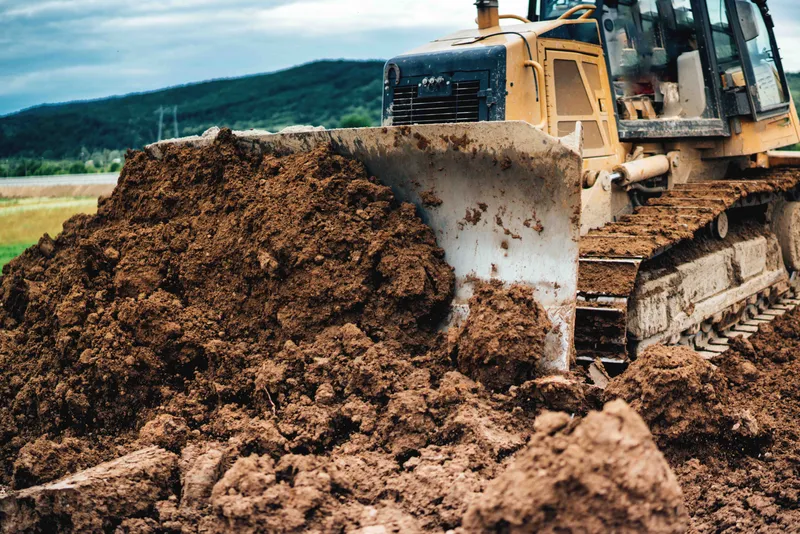
Resource scarcity is an ongoing challenge. Concrete recycling in the construction industry has been gaining importance for some time now. Learn what types exist and why concrete recycling offers many advantages.
The Importance of Concrete Recycling in the Construction Industry
Resources are becoming increasingly scarce. Finite raw materials in particular require highly efficient management. This topic is also omnipresent in the construction industry. After all, large quantities of materials are needed and installed here every day. Resource efficiency therefore plays a major role in the construction sector. On one hand for cost reasons, on the other hand due to steadily increasing demand for energy-efficient and sustainable buildings. The reuse of raw materials is at the top of the list. For example, structural steel has been melted down for reuse for some time now. Now concrete recycling is also gaining increasing importance.
Two Different Types of Concrete Recycling
Provided that the material is sorted by type, concrete can be fully recycled. A distinction must be made between fresh concrete recycling and hardened concrete recycling. The term fresh concrete recycling refers to the internal circulation in the respective concrete plant. Here, concrete waste volumes or unused concrete are deliberately separated and returned to production. The material referred to as waste volumes is obtained when cleaning pumps and mixers at the plant.
Fresh Concrete Recycling: Grain Groups in Residual Concrete and Residual Water in Focus
These waste volumes account for approximately 2.5 percent of total production at a concrete plant. In fresh concrete recycling, fresh water and primary rock aggregates are replaced by specific grain groups contained in the residual concrete and by residual water. How residual concrete, residual mortar, and residual water may be used is regulated by a DafStb guideline (DafStb: German Committee for Reinforced Concrete). Fresh concrete recycling is now performed by virtually all German concrete manufacturers.
Recovery of Residual Water and Rock Aggregates
In terms of processing method, the not yet hardened mortar or concrete is carefully washed out. Through this process, the residual water and rock aggregates can be recovered in the form of an aqueous suspension of fine particles. The rock aggregates have – due to equipment requirements – grain diameters that are larger than 0.125 millimeters or 0.250 millimeters. These are cement particles and similar fine materials. According to DIN EN 1008, the residual water with these particles may be added to fresh water or mixing water in concrete construction. In the industry, this is referred to as residual water recycling. The legally permissible ratio of fresh water to residual water always depends on the required concrete quality and the level of fine particle content in the residual water. It should be noted that high-strength concrete, air-entrained concrete, and other concretes with particularly high quality requirements may generally only be mixed with fresh water.
Concrete Recycling: Study on the Use of Residual Water
However, there are now various papers and scientific studies that advocate for the use of residual water even when recycling high-quality concrete. In particular, a study within the framework of the Industrial Collective Research program (IGF) has dealt comprehensively and in detail with this topic. According to it, the use of residual water leads to a changed processing result, the higher the density of the residual water used. This means it always depends on the water content and fine particle content.
Study Results
- increased early strength
- leads to higher 28-day strengths in concrete with lower target strength
- with respect to the normatively regulated range when using residual water, slightly lower carbonation resistance is observed
- outside the normatively regulated range, carbonation resistance is significantly lower
- in the frost test, concrete without artificially generated air pores experiences increased weathering
Discover klarx advantages for your industry
Hardened Concrete Recycling: Careful Sorting as an Important Prerequisite
In contrast, hardened concrete recycling involves reprocessing concrete waste. The prerequisite for this is careful sorting by material type during building demolition. In the subsequent recycling process, the concrete is broken and sieved by a crusher. This produces recycled concrete sand and recycled concrete aggregate. In the case of reinforced concrete, reinforcing steel is also separately sorted out. This steel scrap can subsequently be melted down and formed into new steel products.
The crushed sand and concrete aggregate can generally be used for various purposes. For example, recycled concrete is produced from concrete aggregate. The corresponding requirements are explicitly specified in the standard DIN 4226-100. For example, when producing recycled concrete, a modified water requirement must be taken into account in the material distribution.
At a Glance – The Advantages of Recycled Concrete
In general, the use of recycled concrete offers various advantages, though some may only become apparent to a construction company in the long term:
- initiates a circular economy, which can be counted among environmental protection measures
- demolition materials and construction waste are not deposited on landfills and mining sites, but are deliberately reprocessed
- no transport costs and no landfill costs
- no costs for new concrete
- reduces the emissions- and energy-intensive production of cement
- brings independence from suppliers and price increases
Disclaimer: Please note that our web service is for informational purposes only and is non-binding. All information provided is without warranty as to correctness and completeness. The content of our website – especially the legal articles – is researched with great care. Nevertheless, the provider cannot assume liability for the accuracy, completeness, and timeliness of the information provided.
This page was automatically translated from German.