#blog · September 19, 2024
Self-Driving Work Machines – What's Coming in the Future?
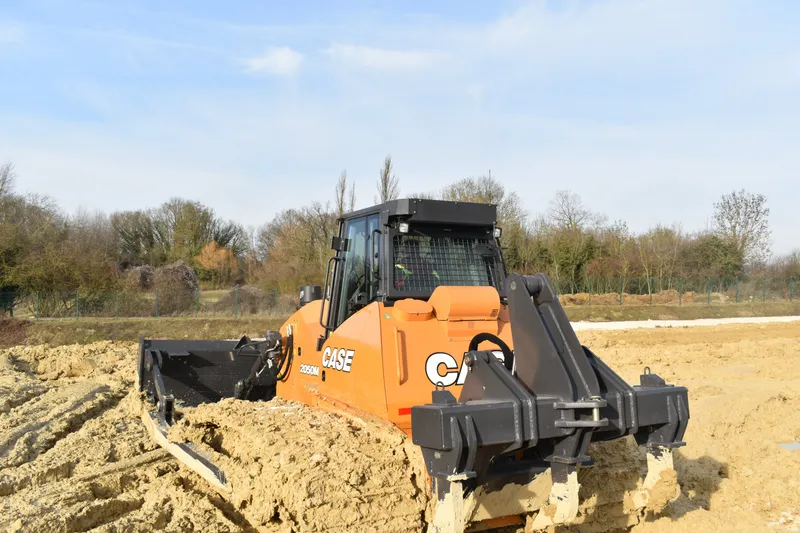
What's behind the idea of "self-driving work machines" and how the construction industry could look in the near future.
Autonomous Work Machines
Whether at "Bauma" or on the 2025 Innovation Agenda – trade shows and conferences are currently focused on alternative drive systems, digitalization, and automation. These developments promise greater efficiency and higher productivity – keywords that catch the attention of both building owners and contractors. But what's really behind self-driving construction equipment?
Autonomy Has Many Faces
To understand the current and future significance of self-driving construction equipment, it helps to define the term more precisely. This way, we can avoid misunderstandings and unrealistic expectations.
Experts speak of self-driving construction equipment or autonomous driving when vehicles move independently on their own. Different levels of autonomy are distinguished. For conventional cars and trucks, five levels have become established:
Level 0 describes driving without assistance; at level 1, the driver has assistance systems available. At level 2, certain processes become partially automated (e.g., parking). At level 3, operation is largely automated. These levels represent today's state. At level 4, driving is permanently taken over by the system; at level 5, completely.
Construction Equipment Has a Modified Classification
Continuous documentation systems that provide faster and better information about work quality form the foundation.
Assistance systems that also intervene in the operation of the construction equipment mark the second level.
Semi-autonomous machines equipped with more or less sophisticated sensors form level 3.
Self-driving machines that operate completely without an operator mark the final stage of development.
Autonomous Construction Equipment Already in Action
Based on these development stages, it's clear: autonomous construction equipment at levels 1 and 2 have been in use for decades in some cases. Large manufacturers in road construction fall into these categories – they record work and perform some tasks automatically. This also includes construction equipment operated with cable or radio remote controls: tower cranes, for example, or trench rollers.
In these and other sectors, the transition to the third level of self-driving construction equipment is underway. Cranes can be equipped with automated collision control; trench rollers compact shaft soil semi-autonomously. Self-driving construction equipment is gaining clear relevance.
Mining is another area where automation is far advanced. In large enclosed mines and quarries, dump trucks and lowbeds have been operating autonomously for several years – equipped with the familiar sensors found in high-end cars. Excavators that automatically excavate a pit are in development.
But the challenges become clear with compacting using rollers and material transport via dump trucks. One major challenge for semi-autonomous machines is precise geometric/geographical positioning. Autonomous lowbeds easily cover the same, often long distance from the extraction area to further processing (closed system). But for the short stretch from the waiting position to the extraction excavator, humans must take over.
Fully Automated Construction Equipment – Still a Long Way Off?
Before semi-autonomous machines master all facets of construction, much time will pass. Fully autonomous construction equipment is – according to machinery manufacturers themselves – still a vision for the future.
One reason is the complex challenges that real job sites and the multifunctional nature of construction equipment pose to the automation process. Unlike industrial automation, job sites are constantly changing. Road construction sites, for example, are not enclosed like mines and are continuously in motion. Experts therefore expect a consolidation phase over the next ten years, in which high expectations gradually adjust to reality.
However, other interesting development steps await in the near future, bringing the goal of building faster, better, and more cheaply closer. Here we're talking about instrumented, connected, and networked machines. They combine automation with digitalization. In the medium term, the latter holds more development potential for improving construction efficiency and productivity.
The Future of Autonomous Construction Equipment – Where Are We Headed?
With automation and digitalization, the construction equipment industry is going through an exciting phase of development. Through autonomous and networked construction equipment, numerous new opportunities for improving efficiency and productivity emerge. In some sectors like mining, semi-autonomous machines are already successfully in operation; on conventional job sites, cranes, drills, and rollers operate semi-automatically. A modern fleet like those maintained by construction equipment rental companies offers a rich selection in this regard.
The path to semi-autonomous construction equipment capable of performing complex work is still long – the path to fully self-driving machines even longer.
Disclaimer:
Please note that our website is provided purely for informational purposes without obligation. All information provided is without warranty as to accuracy and completeness. The content of our website – especially legal articles – is researched with great care. However, the provider assumes no liability for the accuracy, completeness, and timeliness of the information provided.
This page was automatically translated from German.