#blog · September 26, 2024
Rent Mobile Cranes – Everything You Need to Know
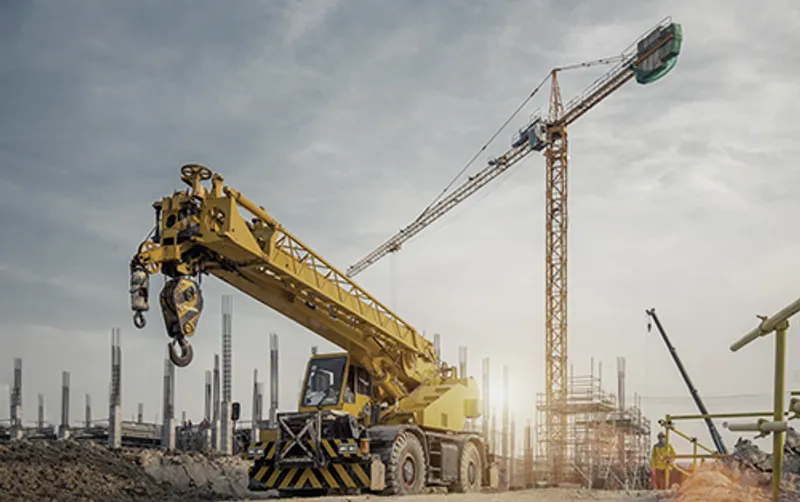
To ensure a mobile crane deployment runs smoothly, there are several important points to keep in mind. Especially if you're new to working with cranes, our information sheet can help you avoid unnecessary delays and extra costs.
Rent Mobile Cranes – Key Information
Transport Permits and BF3 Escort
How high, how far, how heavy? Together with information about obstructions (obstacles), these are the most important details for a lifting project. Based on these parameters, klarx calculates the most cost-effective solution from thousands of possible combinations. A small crane with additional ballast? A larger crane without extra ballast transports, but with a transport permit and BF3 escort? klarx keeps track of all costs and fees and finds the right solution in seconds. Regular customers order their mobile cranes with just a few clicks directly in the klarxMANAGER.
Transport to the Job Site
klarx is responsible for the transport route on public roads from the depot to the job site, handling route planning, transport permits, escort vehicles, police coordination, ballast transport, equipment transport and necessary personnel. Since larger mobile cranes with 4m height, 3m overhang and weights exceeding 100 tons often require complicated routes, this is a major logistical challenge. Up to 60 vehicles can be deployed for a single lift. klarx bills customers for this work at fixed rates.
On the Job Site
At the deployment site, you are responsible for the crane. If the crane must be positioned on public traffic areas, you need to obtain the necessary permits. Keep in mind that lead times for permits, especially in major cities, can be up to eight weeks. You are also responsible for proper site safety measures. However, local service providers are available almost everywhere to handle permits and traffic signs.
Often overlooked are the forces involved in a crane operation. Mobile cranes have high axle loads of at least 12 tons due to their weight. This can damage paved surfaces, pipes or floors. Since klarx cannot accept liability for such damage, you should check in advance whether the ground on private access roads can handle this load. If in doubt, the ground must be reinforced with temporary roads, fill material or similar measures. However, the loads during the crane operation itself are many times higher. The table below shows the maximum corner pressures per crane foot (pad) that can occur. The ground must withstand this to prevent the crane from tipping over. Especially for larger cranes, you should always obtain a structural engineer's report. Ground risk always remains with the rental customer – even experienced field staff cannot reliably determine or estimate ground load capacity without structural reports obtained by your company.
Corner Pressure Table
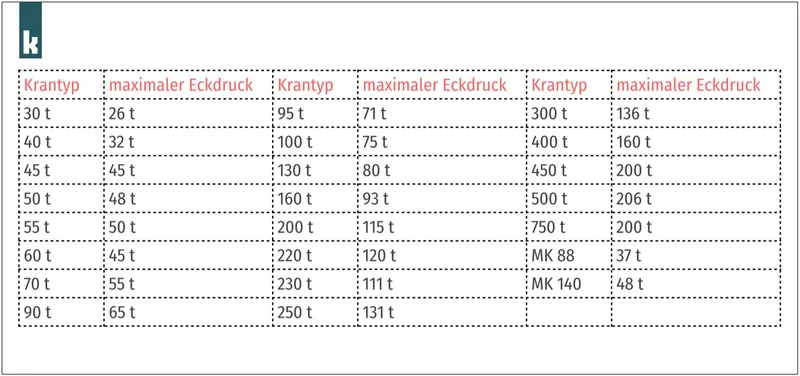
Corner pressure table for mobile cranes
Lifting Gear
Mobile cranes have a crane hook for lifting loads. Usually, lifting gear is also needed to safely raise the load. Chain slings in various lengths and load capacities, spreader bars, concrete buckets, waste skips, glass lifters and load straps are most commonly used. Mobile cranes rarely happen to have exactly the right lifting gear on hand. These must be provided by you. If that's not possible, appropriate lifting gear must be ordered separately and explicitly from klarx.
Responsibility During Crane Operations
When operating mobile cranes and mobile tower cranes, this typically constitutes a Service Type 2 according to our Terms and Conditions for lifting and crane equipment rental. This means the crane and crane operator act under your instructions and direction. They are required and authorized to refuse activities that violate accident prevention regulations, but you bear responsibility for the operation.
Rent Mobile Cranes from klarx
At klarx, you can easily and quickly rent mobile cranes in various configurations. Our team supports customers like you on every job site with expertise and provides digital tools. The same contact person in every city, price certainty and customized processes lead to project success – with our help.
Minimum rental periods are:
- For cranes up to 70 t: 2 hours
- For cranes from 70 t: 4-5 hours
- For cranes from 100 t: 5 hours
- For cranes over 200 t: 8 hours
Discover Mobile Cranes at klarx
Mobile Cranes – Definition and Advantages
Mobile cranes, also called truck cranes, are mobile boom cranes that offer flexible deployment and lower setup costs compared to tower cranes. Unlike mobile tower cranes, mobile cranes can lift heavier loads, but they have limited range of motion and are not suitable for narrow locations.
Disclaimer:
Please note that our website is provided for informational purposes only and without binding commitment. All information provided is without warranty regarding accuracy and completeness. While the contents of our website – especially the legal information – are researched with great care, the provider assumes no liability for the accuracy, completeness and currency of the information provided.
Image Credits:
"Corner pressure table for mobile cranes" © Own representation, "Safety shoes on the construction site" © Canva
This page was automatically translated from German.