#blog · October 22, 2024
Energy Efficiency & Transition: What Habeck's Easter Package Means for the Construction Industry
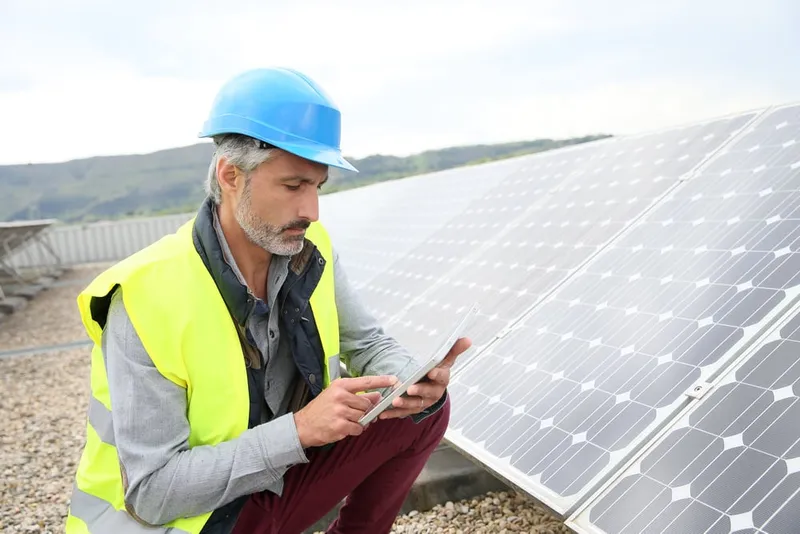
What's behind the federal government's Easter Package? What goals does the Easter Package pursue and how do its contents affect the construction industry? We have answers to all these questions.
Expanding renewable energy by 2035 with the Easter Package
We're making it our shared mission to drastically accelerate the expansion of renewable energy and clear away all obstacles and barriers.
(Coalition Agreement, lines 1801-1802)
To exit fossil fuels as quickly as possible and advance renewable energy expansion, the Federal Ministry for Economics and Climate Protection presented the so-called "Easter Package" to the Federal Cabinet in April 2022. But what exactly is behind this metaphorical term?
The "Easter Package" is a comprehensive legislative package that implements many energy policy contents of the coalition agreement. It represents the largest energy policy legislative change in decades. It comprehensively accelerates renewable energy expansion – on water, on land, and on rooftops.
The goal: By 2035, electricity in Germany should come almost entirely from renewable energy sources.
What measures are in the Easter Package?
First, we'd like to note that the Easter Package's content is quite comprehensive. Below, we address the points most important for the construction industry.
The Easter Package will, among other things:
- create new areas for expanding photovoltaics (PV)
- enable greater community participation in PV and wind power projects
- equip wind-weaker locations with the latest system technologies
- designate more space for offshore wind power in the North and Baltic seas
- reduce obstacles in planning and permitting for grid expansion and wind power development
A key role is played by the new classification that the use of renewable energy is in the "overriding public interest" and thus serves "public safety." The escalating climate crisis and Russia's unlawful invasion of Ukraine show us how important it is to switch to renewable energy. On one hand, renewable energy drives climate protection; on the other hand, the transition leads to reduced dependence on other countries.
With the planned measures, the expansion of wind and solar energy – which has barely advanced in Germany in recent years – should finally be realized. The planned actions should come into force as quickly as possible and remove "obstacles and barriers" for renewable energy. The approval processes for wind turbines take an extremely long time due to many regulations – far too long:
"One of our customers has been planning the construction of wind turbines for 1.5 years – because the approval processes are proving to be very time-consuming and difficult, we haven't been able to deliver the suitable construction equipment via klarx yet," explains Fabian Landstorfer, Key Account Management at klarx.
That and much more is set to change with the Easter Package. In total, 56 legislative amendments are planned. The focus is on accelerated renewable energy expansion. It's also driven by the elimination of German bureaucracy. Applications, review procedures, and bidding processes are simplified and accelerated.
What does the energy transition mean for the construction industry?
For onshore wind energy, expansion rates are being increased to 10 GW per year, so that by 2030 onshore wind energy systems totaling around 115 GW should be installed in Germany. For solar energy, expansion rates are being increased to 22 GW per year, so that by 2030 solar systems (roof installations, ground-mounted systems, special solar installations) totaling around 215 GW should be installed in Germany (Source).
For comparison: In 2020, Germany saw the construction of 1,431 megawatts, i.e., 1.4 GW or 420 onshore wind energy systems. The federal government is projecting significant growth here (source no longer available: https://www.enercon.de/de/aktuelles/enercon-begruesst-osterpaket-der-deutschen-bundesregierung/).
What klarx customers say about the Easter Package
But what do these measures really mean for the construction industry? And for our customers in the photovoltaic and geothermal sectors?
ENERCON GmbH is Germany's largest manufacturer of wind energy systems and one of our most loyal customers. "After years of market decline, a renaissance of wind energy in Germany is in sight – we're very pleased about that," explains ENERCON CEO Dr. Jürgen Zeschky. "As a manufacturer of wind energy systems, we will support this endeavor to the best of our ability." (source no longer available: https://www.enercon.de/de/aktuelles/enercon-begruesst-osterpaket-der-deutschen-bundesregierung/)
Also, Enpal is profiting enormously from the Greens' new legislative changes. The advantage of solar, of course, is that demand doesn't just come from the state – private households increasingly prefer solar on their roofs. "Given the energy crisis gripping Germany for weeks, there's much to be done. Demand has really exploded – I've never experienced anything like this," co-founder Mario Kohle said in the podcast 'The Zero Hour'. "Since the start of the war and rising energy prices, it suddenly became clear to many people that they want a solar system – or also storage, heat pumps, and electric cars." (Source)
One thing is certain: For our customers, this means construction projects can start faster as approval processes are shortened. Plus, PV and wind power systems receive more attention. And that's good: After all, wind power is the second most important energy source, despite expansion difficulties. (source no longer available: https://www.zdf.de/nachrichten/wirtschaft/windkraft-weltweite-energiequelle-grafiken-100.html)
What does the Easter Package mean for klarx?
The expansion of renewable energy is closely tied to our company philosophy, which gives great attention to "sustainable construction industry." Robert Habeck is sending a signal with the Easter Package – a signal for the necessity that things must change – for a climate-neutral Europe.
With the Easter Package's measures, we can better support our customers in realizing sustainable construction projects. Reducing lengthy approval processes brings better planning and faster action for both sides.
But above all, one point is highly relevant here: Renewable energy, including photovoltaics and geothermal, is crisis-proof. Looking at the past and future shows us that there is great potential there and it will remain indispensable in the future.
At klarx, we're committed to sustainable construction projects and bring a lot of expertise in this field. More information can be found on our Photovoltaics page.
Disclaimer:
Please note that our website offering is for informational purposes only and without obligation. All information provided is without guarantee as to accuracy and completeness. The contents of our website – especially legal articles – are researched with great care. Nevertheless, the provider cannot accept liability for the accuracy, completeness, and timeliness of the information provided.
This page was automatically translated from German.