#blog · September 19, 2024
Driving Wheel Loaders on Public Roads - What You Need to Know
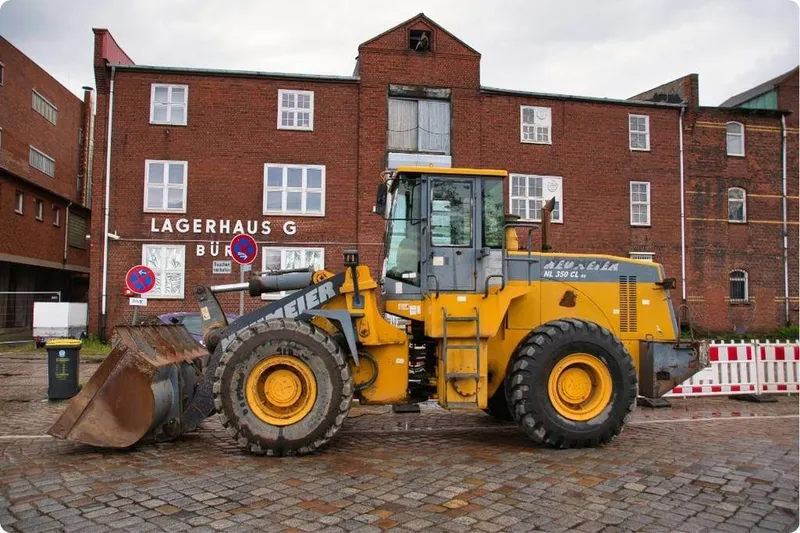
If you want to drive a wheel loader on public roads, this requires special attention to road-worthiness and compliance with traffic regulations. In this article, you'll learn which approval requirements and driver's license requirements you must meet to operate a wheel loader safely and legally on the road.
Can You Drive a Wheel Loader on Public Roads?
Legal Framework
You can only drive a wheel loader on public roads under certain conditions. However, these regulations may vary by federal state. Basically, traffic rules must be followed and appropriate approval must be in place. By definition, a wheel loader is "not a machine approved for road traffic". Nevertheless, there are exceptions that allow the vehicles to be driven on public roads under certain conditions.
Approval Requirements
To register a wheel loader for public road use, certain technical requirements must be met and necessary documents must be submitted. This includes, among other things, proof of road-worthiness and compliance with all relevant traffic regulations. A wheel loader must have operating approval under the Road Traffic Licensing Regulation (StVZO) to be driven on public roads. This includes, for example, equipping the machine with appropriate lighting and license plates.
Wheel loaders up to 20 km/h:
If it's a wheel loader with a maximum top speed of 20 km/h, the equipment is registration-free. It is thus exempt from the registration procedure that is mandatory for other motor vehicles. Although the obligation for regular main inspection also no longer applies, wheel loaders require an annual inspection according to occupational association guidelines.
Wheel loaders over 20 km/h:
While wheel loaders with a maximum speed of up to 20 km/h only require operating approval, wheel loaders exceeding 20 km/h are subject to stricter rules: These vehicles are also registration-free in terms of motor vehicle tax exemption, but they require an official license plate (green) from the local registration authority. For such machines, a registration certificate part 1 (vehicle registration document) is issued.
Operating Approval for Registration-Free Wheel Loaders
The most important requirement for driving on public roads with registration-free wheel loaders is general operating approval. It replaces the registration certificate and serves as proof that the wheel loader is basically suitable for the defined use. Since there is no uniform form of operating approval in Germany, the following documents are suitable for this purpose:
- Declaration of Conformity (CoC)
- General Operating Approval (ABE), issued by the Federal Motor Transport Authority
- TÜV or DEKRA certification according to § 13 EG-FG or § 21 StVZO
But be careful:
Trailer operation is only permitted for all wheel loader types if
- the construction machine has a tested coupling
- and the trailer and support load are entered in the operating approval or registration certificate.
The transport of persons or goods in public spaces is absolutely prohibited.
What Driver's License Do You Need for a Wheel Loader?
To drive a wheel loader on public roads, you generally need a specific driver's license class. The required class depends on the size and weight of the vehicle. Frequently required classes are L, T, B, and C. Class L is suitable for small agricultural or forestry vehicles, while classes B and C are required for larger construction machines. For wheel loaders up to 20 km/h, a driver's license of class 5 or L is required. For registered wheel loaders over 20 km/h, the weight limit applies. This means that the required driver's license class depends on the permissible total weight of the construction machine.
Wheel Loader Operation on Public Roads: Safety Measures and Tips
When driving a wheel loader on public roads, certain safety precautions must be observed. These include proper seat belt use, regular vehicle maintenance, and compliance with all traffic regulations. Additionally, the machine should be equipped with warning lights to be more visible in road traffic.
For all wheel loader types, the following equipment must be carried:
- First aid kit
- Warning vest and warning triangle
- Warning light for vehicles with a permissible gross weight of 3.5 tons or more
- Wheel chock for vehicles with a permissible gross weight of four tons or more
How Do I Prepare the Wheel Loader for Driving?
Before the wheel loader leaves the job site and can drive on public roads, several preparations must be made. This includes attaching a sign with the first and last name and residential address of the owner on the left side of the vehicle. Companies note their business data on the sign. For wheel loaders under 20 km/h, speed limit signs marked "20 km/h" on the left and right sides and at the rear are mandatory. Wheel loaders over 20 km/h must be registered and therefore require a (green) license plate.
Challenges When Driving a Wheel Loader
Among the most common challenges when driving a wheel loader on public roads are narrow streets and heavily trafficked areas. Practical tips include avoiding rush hour and using less-traveled routes. Knowledge of the maximum permissible speed for wheel loaders on public roads is also important to avoid fines and accidents. Before departure, also cover all sharp-edged parts and use tooth protection for the bucket of the vehicle. Well-secured, the construction machine is well-prepared for public traffic.
Alternative Transport Options for Wheel Loaders
If driving on public roads is not possible or advisable, transporting a wheel loader on a trailer is a good alternative. Make sure the trailer is properly secured and approved for transport. The wheel loader should be properly tied down to prevent slipping during transport.
Liability and Insurance for Wheel Loaders on Roads
There is no insurance requirement for registration-free wheel loaders. When you rent a wheel loader, the risk of damage often lies with the renter—you. Clarify this when renting to ensure which contracting party covers the risks. As a private renter, you cover the risks through your private liability insurance, provided this has been clarified with your insurer in advance. Make sure all agreements are documented in writing to avoid misunderstandings.
Conclusion
Operating a wheel loader on public roads requires compliance with approval requirements, driver's license requirements, and traffic regulations. By adhering to these requirements and applying practical safety measures, you can travel safely and legally.
Disclaimer:
We would like to point out that our web offering is for informational purposes only and is non-binding. All information provided is without warranty as to accuracy and completeness. The content of our website—especially legal articles—is researched with great care. Nevertheless, the provider assumes no liability for the accuracy, completeness, and timeliness of the information provided.
This page was automatically translated from German.